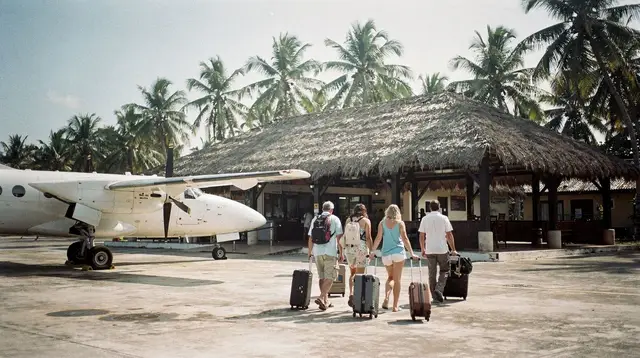
From PUJ airport to your hotel
How long does it take to get from PUJ airport to a Punta Cana hotel?
Most hotels in Bavaro and Cap Cana are 15 to 40 minutes from Punta Cana International Airport (PUJ) by road. Uvero Alto, further north, takes 40 to 60 minutes. A private transfer or a fixed-rate taxi are the two practical options at arrival.
The first hour after landing
Punta Cana International Airport (PUJ) is a small, open-air terminal building, not a sprawling hub, and clearing it is usually quick once your flight is on the ground. The sequence is the same for everyone: immigration, baggage claim, customs, then the arrivals hall where drivers and taxi dispatchers wait. What varies is how far you then have to travel, and that depends entirely on which sector your hotel sits in.
This page covers exactly that leg: airport to hotel, on arrival day. It does not cover how you get around once you are settled in, which is a separate question with its own set of options (see getting around Punta Cana), and it does not cover renting a car and driving yourself, which has its own logistics and costs (see renting a car in the Dominican Republic).
Drive times by hotel zone
Punta Cana International Airport sits close to the coastal strip that runs from Cap Cana in the south through Bavaro and up toward Uvero Alto. Road distance, not straight-line distance, is what matters here, since there is no train and the coastal road can slow down around midday.
| Hotel zone | Typical drive time from PUJ | Notes |
|---|---|---|
| Cap Cana | 15-25 minutes | Closest sector to the airport, marina area |
| Bavaro (most hotels) | 20-40 minutes | Largest hotel zone, drive time depends on how far into Bavaro |
| Uvero Alto | 40-60 minutes | Further north, more isolated, longest transfer |
If your booking confirmation just says “Punta Cana” without naming the resort, check which sector it is actually in before you assume a short transfer. The name “Punta Cana” is used loosely for the whole coastal zone, and a hotel technically in Uvero Alto can still be marketed as “Punta Cana” even though the transfer is close to an hour rather than twenty minutes. For a fuller breakdown of what these sector names actually mean, see Punta Cana vs Bavaro vs Cap Cana vs Uvero Alto.
Traffic near the airport roundabout and along the main hotel access roads can add 10 to 15 minutes during peak arrival windows, typically late morning and mid-afternoon when several international flights land close together.
Two formalities before you even think about a taxi
Two pieces of paperwork determine whether your arrival is smooth or held up, and both are worth handling before you fly rather than at the airport.
The e-Ticket
The e-Ticket is a free online form that covers both the customs declaration and the immigration/health information previously handled with separate paper forms. It is mandatory for every traveler entering or leaving the Dominican Republic, filled out online before the flight. Airlines and immigration officers can ask to see the QR code generated after submission, so it is worth saving a screenshot or printing it rather than relying on finding signal at the airport. This applies on the way out too: fill it out again before your return flight. Full details, including what happens if you forget, are in the e-Ticket and entry rules guide.
The tourist card
The Dominican Republic charges a 10 USD tourist card for most visitors, but this is not something you pay separately at an immigration desk. It is bundled into the price of the vast majority of flights arriving from Europe, North America and the rest of South America. If a uniformed-looking person in the arrivals area tells you that you need to pay for a tourist card before you can proceed, that is not a legitimate airport charge and you can safely walk past. Passport validity for the full length of your stay is expected as usual.
Nationals from the EU, the UK, the US, Canada and most of South America do not need a separate tourist visa for a standard stay of up to 30 days; longer stays can be extended at the airport on departure for a fee.
Getting from arrivals to your hotel: the options
Once you are through customs and into the arrivals hall, there are two practical ways to cover the drive to your hotel.
Private transfer booked in advance
A private transfer is arranged before you fly. A driver waits in the arrivals hall holding a sign with your name, the price is agreed beforehand in USD, and the vehicle goes directly to your hotel with no other stops. This is the option that removes the most uncertainty from a long travel day, particularly if you are arriving late at night, traveling with young children, or heading to a more distant sector like Uvero Alto where finding a taxi driver willing to make the trip can take longer.
a private transfer from the airport straight to your hotel door is the most straightforward way to lock in the price and the pickup before you leave home. For groups or families with extra luggage, an SUV transfer with more space per vehicle avoids splitting into two cars. There is also a simpler standard airport transfer covering the PUJ-to-hotel route for travelers who just want the basics at a lower price than a VIP vehicle.
Fixed-rate taxi at the airport
Taxis at PUJ operate on a fixed-rate system by zone rather than a meter, with rates posted at the official taxi desk inside the arrivals area. This works fine if you would rather decide on the spot, but it means negotiating (even at a fixed published rate) after a long flight, and availability for the longer Uvero Alto run can be thinner outside peak hours. Payment is generally accepted in US dollars, with any change given back in Dominican pesos.
Ride-hailing apps are not a reliable option for the airport leg specifically: coverage and driver access to the terminal area is inconsistent, and this is a case where the fixed-rate taxi desk or a pre-booked transfer are simply more dependable than trying to hail a ride app pickup. Once you are at your hotel, app-based options and local buses become more workable for day-to-day trips.
What a typical arrival looks like, sector by sector
For a hotel in Bavaro or Cap Cana, budget 20 to 40 minutes on the road after leaving the terminal. This is short enough that a fixed-rate taxi is a reasonable choice if you would rather not book ahead, though a private transfer removes the small risk of taxi queues during a busy arrival window.
For a hotel in Uvero Alto, the 40 to 60 minute drive is long enough that booking a private transfer in advance is worth the extra planning, especially for a late-night arrival. Fewer taxis run this route by default, and turning up at the taxi desk asking for Uvero Alto can mean a longer wait than travelers heading to Bavaro.
If your trip includes a side visit to Santo Domingo, note that it uses a different airport altogether, Las Americas (SDQ), not Punta Cana International (PUJ), and the drive between the two cities is a separate 2.5 to 3 hour trip in its own right, not something to combine with your PUJ arrival day.
Currency and small costs at the airport
If you plan to tip a driver or buy a coffee before pickup, a few US dollars in small bills is the most useful thing to carry off the plane. The Dominican Republic’s currency is the peso (DOP), not the euro, though USD is widely accepted in the tourist zone and on prepaid excursions; change from a cash payment usually comes back in pesos. A broader look at cash, tipping and the restaurant tax and service charge you will see on receipts throughout your stay is covered in money, tipping and taxes in Punta Cana.
Timing your arrival
The time zone here is Atlantic (UTC-4) year-round, with no daylight saving shift, so a flight time that looks convenient from home does not need adjusting for a seasonal clock change once you land. What does matter is the time of day you land relative to airport traffic: a midday arrival can mean a slower roundabout, while a late evening or overnight arrival means a quieter road but a stronger case for a pre-booked transfer with a driver confirmed to be waiting regardless of the hour.
If your travel dates fall during the wetter half of the year, June through November, keep in mind that heavier rain showers are more common and can occasionally slow traffic on the main access roads; this is separate from hurricane season risk, which peaks August through October and is covered in its own guide.
Common mistakes on arrival day
- Assuming “Punta Cana” on the booking means a short drive. Check the actual sector; a hotel in Uvero Alto can still be sold under a generic “Punta Cana” label.
- Paying for a tourist card at the airport. It is already included in almost every flight ticket; a request for separate cash at arrivals is not legitimate.
- Skipping the e-Ticket before the flight. It is free but mandatory, and trying to complete it on a phone with no signal at the terminal is avoidable.
- Not confirming a transfer pickup point in advance. Arrivals halls can be busy with several flights landing close together; a driver holding a clearly visible name sign avoids confusion.
- Underestimating the Uvero Alto drive. 40 to 60 minutes is a real transfer, not a short hop, and matters for late arrivals with young kids on board.
More arrival-day pitfalls, and mistakes that show up later in the trip, are rounded up in Punta Cana travel mistakes to avoid. If this is your first time in the region, Punta Cana for first-time visitors and where to stay in Punta Cana are useful next reads before you land, and a rough plan for your first days is laid out in three days in Punta Cana and how many days in Punta Cana.
FAQ: from PUJ airport to your hotel
How far is Punta Cana airport from my hotel?
It depends on the sector. Hotels in Bavaro and Cap Cana are typically 15 to 40 minutes away by road. Uvero Alto is further north and takes 40 to 60 minutes. Traffic near the airport roundabout can add time around midday.
Do I need to pay for a tourist card on arrival?
No. The 10 USD tourist card is already included in the price of most flights to the Dominican Republic. If someone at the airport asks you to pay for it separately, that is not a legitimate airport fee.
What is the e-Ticket and is it really mandatory?
The e-Ticket is a free online form covering both customs and immigration for entry and exit. It replaced the old paper forms and it is mandatory for every traveler, filled out before the flight, ideally with a few days’ buffer and no later than departure.
Should I book a transfer in advance or take a taxi at the airport?
Both work. A pre-booked private transfer means a driver is waiting with your name at arrivals and the price is fixed before you land. An airport taxi is booked on the spot at a fixed rate per zone, which is simple but leaves you negotiating after a long flight.
Is Uber available at Punta Cana airport?
Ride-hailing coverage at the airport itself is unreliable and drivers are often turned away from the terminal area. For the airport-to-hotel leg, a booked transfer or the official taxi stand is the more dependable option; day-to-day options are covered in getting around Punta Cana.
Can I rent a car right at the airport instead of taking a transfer?
Yes, several rental counters operate at PUJ, but that is a different decision with its own costs and driving conditions, covered separately in renting a car in the Dominican Republic.
What currency should I use to pay a taxi driver at the airport?
US dollars are widely accepted for airport taxis and transfers, and change is usually given in Dominican pesos (DOP). Small bills make this easier.
Does the drive time change between Punta Cana airport and Bavaro versus Cap Cana?
Both are close to the airport and generally fall in the same 15 to 40 minute range, with resorts near the Cap Cana marina sometimes at the shorter end and hotels deeper into Bavaro at the longer end.
Getting around Punta Cana on GetYourGuide
Verified deep-linked GetYourGuide tours. Book through these links and we earn a small commission at no cost to you.
GetYourGuide does not provide a product photo for this activity — the image shows the meeting point, photographed by us.