Where Punta Cana actually starts and ends
Punta Cana, in the strict sense, is a cape: the easternmost point of the Dominican Republic, where the Caribbean Sea meets the Atlantic. That is not what most people mean when they say they are “going to Punta Cana.” In everyday use, the name has stretched to cover the entire tourist corridor that runs north from the cape through Bavaro, into Cap Cana, and further up toward Uvero Alto and Macao. These are four separate sectors with different hotels, different beaches and, in one case, a meaningfully longer drive from the airport. None of them is a synonym for the others, and mixing them up is the single most common source of confusion for anyone booking a trip here.
This page treats Punta Cana as the cape and the immediate zone around Punta Cana International Airport (PUJ) — the corridor where the airport, the main catamaran piers, the buggy ranches and Hoyo Azul all sit within about half an hour of each other. For beach-by-beach and hotel detail on the adjacent sectors, see the Bavaro and Cap Cana pages; this one is about getting oriented on arrival and understanding why the name on your flight confirmation covers so much ground.
Landing at PUJ: your first hour
Almost every international visitor to this coast arrives through Punta Cana International Airport. It is an open-air terminal, which surprises first-timers, and it sits close enough to the resort strip that most hotels in Bavaro and Cap Cana are a 15 to 40 minute drive away. If your hotel is in Uvero Alto, budget more: that sector is further north and less directly connected, and transfers there typically run 40 to 60 minutes.
Two paperwork items matter before you board your outbound flight, not after you land: the e-Ticket, a free online form that is mandatory for both entry and exit, and the tourist card, a 10 USD fee that is bundled into the price of most flights to the Dominican Republic rather than collected separately at immigration. Citizens of the EU, UK, US, Canada and most South American countries do not need a separate visa for a standard 30-day tourist stay, but everyone needs a passport valid for the full length of the trip and a completed e-Ticket. For the full breakdown of forms and rules, see entry rules for the Dominican Republic; for a step-by-step on the transfer itself, see airport transfers and getting around by taxi, Uber and guagua.
Once you clear the terminal, private transfers and fixed-rate taxis are the default way to reach your hotel. There is no rail network on this coast, and rental cars are less common for a short resort stay than a pre-booked transfer, though they exist. Dominicans drive on the right, and outside the resort corridor traffic can be dense around Higuey and the airport roundabouts at peak arrival times.
Why “Punta Cana” means more than the cape
The confusion is not accidental. Decades of tourism marketing folded Bavaro, Cap Cana, Uvero Alto and Macao under one umbrella name because “Punta Cana” was the airport code and the phrase that stuck internationally. On the ground, though, each sector has its own character:
| Sector | What it actually is | Distance from PUJ |
|---|---|---|
| Punta Cana (the cape) | The eastern point itself; also the loose name for the whole corridor | At the corridor’s south end |
| Bavaro | Densest hotel strip, widest beaches | 15-30 min |
| Cap Cana | Upscale marina district, golf, Scape Park | 15-25 min |
| Uvero Alto | Northern, quieter, more isolated hotels | 40-60 min |
| Macao | Public surf beach, buggy country | 20-35 min |
If you are trying to decide where to stay rather than just understand where you landed, the side-by-side comparison in Punta Cana vs. Bavaro vs. Cap Cana vs. Uvero Alto goes into beach width, hotel density and nightlife access for each sector. This page assumes you are already booked somewhere in the corridor and want to understand the ground you are standing on.
What sits within reach of the cape itself
Treat the immediate Punta Cana zone as the hub for a cluster of things that are genuinely close together: the airport, the marina piers where catamarans and party boats depart, the buggy and ATV ranches, and Hoyo Azul, the cenote inside Cap Cana’s Scape Park. None of these require a long day-trip drive; they are the excursions people book for their first or second day, often straight from the hotel tour desk or a laptop before they even land.
A short boat ride from the piers near Bavaro and Cap Cana reaches a shallow sandbar known locally as the natural pool, a common stop on catamaran and party-boat routes. If a lively, music-heavy boat with a bar on board sounds right for your group, the adults-only party boat out to the natural pool covers that stretch of water without the family crowd. For a quieter version of the same area, the half-day snorkeling trip to the natural pool trades the speakers for mask-and-fin time over the sandbar and nearby reef.
Inland, the buggy circuits that start a short drive from the hotel strip run through cane fields, small villages and the coastline near Macao. If off-road driving is the point, the Buggy El Patron route is one of the more established options departing from this corridor; drivers who prefer four wheels over a buggy frame will find similar routes badged as go-karting rather than off-roading. For a slower, cultural counterpoint to the water and off-road tours, a small-group outing built around local history and traditions gives context on the country beyond the resort fence.
None of this means you should expect to see everything the region offers without leaving your hotel property for more than a few hours at a time. Hoyo Azul and the rest of Scape Park sit inside Cap Cana proper — covered in full on the Hoyo Azul and Scape Park guide — and the Puntacana Resort’s Indigenous Eyes ecological reserve is a separate, gated nature park with its own entry. Both are close, both are bookable as half-day add-ons, but neither is something you stumble into from a public beach.
How much time to actually set aside
A realistic first-time visitor spends the arrival day and the following morning settling in, then starts exploring. Give yourself half a day just to get oriented — figure out where the nearest public beach access is versus your resort’s private stretch, check what the tour desk is quoting against online prices, and confirm which sector you are actually in relative to the map you saw before booking. After that, three to five days is enough to combine a beach day, one water excursion near the cape, one land-based tour (buggy, horseback or cultural), and still have downtime at the resort. Trying to add a day trip to Saona Island or Santo Domingo on top of that is possible but changes the pace of the trip considerably, since both require significant road time before the excursion itself begins.
For a structured plan rather than a loose list, the three-day Punta Cana itinerary lays out a sequence that keeps transfer time reasonable and does not try to cram a Samana or Santo Domingo trip into a short stay.
Money, timing and practical notes
The currency is the Dominican peso (DOP, often written RD$), not the euro. US dollars are widely accepted at hotel tour desks, on excursions and in tourist-facing shops, but change is usually handed back in pesos, so carrying a mix is more practical than assuming dollars alone will cover everything. Restaurant bills in and around the resort corridor generally add an 18% ITBIS tax plus a 10% service charge, sometimes labeled “ley” on the receipt — a combined markup worth checking for before you tip on top of it.
The country runs on Atlantic Standard Time (UTC-4) year-round; there is no daylight saving adjustment, so the time difference from Europe or North America shifts depending on their own clock changes. Electrical outlets are the US-style 110-120V type A/B, so European visitors need an adapter. Tap water is not safe to drink; stick to bottled or filtered water, including for brushing teeth if you are being cautious.
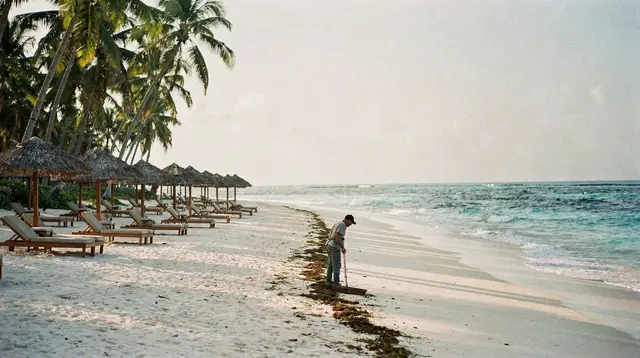
Weather in the Punta Cana zone is tropical year-round, typically 26-31°C. December through April is the drier, less humid stretch and the busiest tourist season; May through November is more humid, and hurricane season runs June through November with the highest risk in August, September and October. Sargassum — brown seaweed — can wash up on east-coast beaches, most commonly between April and October, though how much arrives varies year to year and is not predictable from a hotel’s marketing photos. None of this rules out a trip in the wetter months, but it is worth knowing before you book, especially if a seaweed-free beach is non-negotiable for your plans.
Getting beyond the immediate corridor
Once the cape and its immediate surroundings feel familiar, the rest of the eastern Dominican Republic opens up, though not on the same short-drive scale. Saona Island is a common bucket-list stop, but it departs from Bayahibe, roughly 1 hour 15 minutes to 1 hour 45 minutes south by road before you even board a boat — it is not a quick excursion from a Punta Cana pier despite how it is sometimes marketed. Santo Domingo’s colonial zone is a genuine highlight for history, but it is 2.5 to 3 hours away by road, a full-day commitment rather than a half-day add-on. Whale watching in Samana Bay is real and worth planning around, but it only happens from roughly mid-January to late March and only in Samana — never near the cape itself, regardless of what a tour brochure might imply.
Frequently asked questions about Punta Cana as a destination
Is Punta Cana a city or just a beach?
Neither, exactly. Punta Cana is technically a cape at the eastern tip of the Dominican Republic. There is no traditional town center; the name is used to describe the surrounding resort corridor, which includes separate sectors like Bavaro and Cap Cana.
What is the difference between Punta Cana, Bavaro and Cap Cana?
Punta Cana refers loosely to the whole resort zone and, specifically, to the cape itself. Bavaro is the densest hotel strip with the widest public beaches. Cap Cana is a more upscale district south of Bavaro with a marina, golf courses and Scape Park. They sit close together but are distinct sectors, not different names for the same place.
How far is the airport from my hotel?
Most hotels in Bavaro and Cap Cana are 15 to 40 minutes from Punta Cana International Airport (PUJ) by road. Hotels in Uvero Alto, further north, typically take 40 to 60 minutes.
Do I need a visa to visit Punta Cana?
Travelers from the EU, UK, US, Canada and most South American countries do not need a separate visa for a standard tourist stay of up to 30 days. You do need a passport valid for your full trip, a completed e-Ticket form, and the tourist card, which is usually already included in your airfare.
Can I drink the tap water in Punta Cana?
No. Tap water is not considered safe to drink in this area. Stick to bottled or filtered water throughout your stay.
Is the euro accepted in Punta Cana?
No. The official currency is the Dominican peso (DOP). US dollars are widely accepted in tourist areas and on excursions, but change is typically given in pesos, so the euro is not a practical currency here.
How many days should I plan for Punta Cana?
Three to five days is a reasonable minimum if you want a beach day, at least one water excursion and one land-based tour, plus some resort downtime. Add extra days if you also want a day trip to Saona Island or Santo Domingo, both of which involve significant road or boat time.
When is the best time to visit Punta Cana?
December through April is drier and less humid, and it is the busiest and most expensive season. May through November is more humid, with hurricane season running June through November and the highest storm risk in August, September and October.