Where this region actually sits
This part of the site covers the south coast: La Romana, the fishing-village-turned-boat-harbor of Bayahibe, the replica village of Altos de Chavón, and the two islands most day trips are built around, Isla Saona and Isla Catalina. It’s a different zone from the Punta Cana and Bavaro hotel strip, and the most common mistake in trip planning is treating it as an extension of the resort beach rather than a separate destination that needs its own transfer time.
The one thing worth fixing before anything else: Saona Island is never a direct excursion from Punta Cana. Every legitimate boat to Saona departs from Bayahibe, inside Cotubanama National Park (formerly known as Parque Nacional del Este). If you’re staying in Bavaro or Cap Cana, or further out in Uvero Alto, the excursion you book will include a road transfer of roughly 1h15 to 1h45 to reach Bayahibe before you set foot on a boat. Operators build this into the published start time, but it’s easy to underestimate if you’re picturing a short hop from your hotel’s beach. Treat any excursion advertised as “Saona from Punta Cana” as shorthand for “Saona, with a transfer from Punta Cana included,” not as a nearby outing.
La Romana: the practical hub, not the main event
La Romana is a mid-sized Dominican city a short drive from Bayahibe. For a traveler based in Punta Cana, its main role is logistical: it’s the town cruise ships dock at, the town most Bayahibe- and Altos de Chavón-bound excursions route through, and the nearest urban center with an airport (La Romana International, used more by charter and private flights than the main tourist traffic through Punta Cana International Airport (PUJ)).
On its own, La Romana has limited sightseeing value for a resort-based visitor. Its importance is as a hinge point: from La Romana, it’s a short onward drive to Bayahibe’s harbor for boat departures, and a similarly short drive to Altos de Chavón. If you arrive by cruise ship into La Romana’s port, this hinge works in your favor — Altos de Chavón in particular is close enough to fit into a half-day shore excursion, though combining it with a Saona or Catalina boat trip on the same cruise call is usually too tight given fixed return times.
Some excursions marketed to cruise passengers bundle a buggy safari around the La Romana countryside with a stop at Altos de Chavón or at cave sites like Cueva de las Maravillas. If you’re arriving by ship rather than from a Punta Cana hotel, this kind of combined tour makes more sense than trying to add an island crossing to the same day.
Bayahibe: where the boats actually leave from
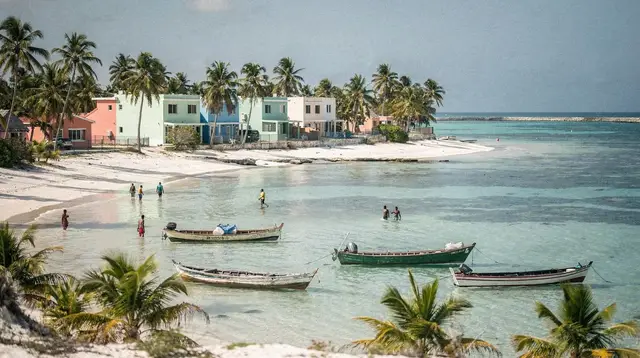
Bayahibe started as a fishing village and is now the main departure point for boats into Cotubanama National Park, which contains both Isla Saona and the open water route toward Isla Catalina. The harbor itself is modest — small boats, dive shops, a handful of waterfront restaurants — and most visitors pass through it quickly on their way to a boat rather than staying to explore the village itself, though it’s a reasonable base if you’re not commuting daily from Punta Cana.
The standard Saona format pairs two different boats: a fast speedboat for one leg and a catamaran for the return (or the reverse), with a stop at a shallow sandbar area often marketed as a “natural pool,” where guides typically hand out starfish for photos. If you book this kind of excursion, expect the full outing — transfer, boat, island time, return — to run a full day, not a half-day.
Bayahibe is also a base for other activities that don’t run through Saona at all: buggy and ATV routes through the surrounding countryside and along the beach and river near Bayahibe, and dedicated diving trips built around local wreck and reef sites. Those activities, along with the mechanics of choosing a specific Saona or Catalina tour, belong to the dedicated guides for this area rather than to this regional overview — this page is here to orient you toward the right destination, not to sell you a specific departure time.
a Saona Island boat day with lunch included, departing from the La Romana/Bayahibe area is the closest thing to a standard-format excursion here, and a reasonable starting point if you haven’t compared options yet.
Isla Saona: the big island, not a quick stop
Isla Saona sits inside Cotubanama National Park and is the destination most people mean when they say they’re doing “the island excursion” from this coast. It’s a genuinely large island with long, largely undeveloped beaches, and the appeal is the beach and sandbar time rather than any built attraction. Because access is only by boat from Bayahibe, and because the round trip plus transfer eats most of a day, Saona works best as a single dedicated day rather than something squeezed alongside other sightseeing.
Two honest caveats worth knowing before you book: sea conditions and crowding both vary by season and by which operator’s boat you’re on, and the “natural pool” stop can get busy when several boats arrive at once. None of that makes Saona not worth doing — it regularly ranks as one of the most-booked excursions from this coast — but it’s not the quiet, private-beach experience some marketing implies. For the specifics on what the natural pool stop involves and the etiquette around handling starfish there, see the dedicated Saona natural pool and starfish guide rather than relying on this overview.
Isla Catalina: smaller, and mainly for the reef
Isla Catalina lies off the coast near La Romana and is a different kind of stop from Saona — smaller, less developed for large groups, and primarily known for its reef wall rather than for beach lounging. It’s the better choice if snorkeling or diving is the actual goal of your day, since the underwater visibility and reef structure around Catalina tend to draw more serious water-sports interest than Saona’s shallower sandbar areas.
Some Catalina-bound tours combine the boat crossing with a buggy segment around the La Romana countryside beforehand, which is worth knowing if you’re deciding between a straightforward boat-only itinerary and a mixed land-and-sea day. a combined buggy excursion around La Romana followed by a Catalina Island boat crossing is one way operators package this pairing. As with Saona, the detailed comparison of snorkel quality, dive add-ons and specific operators belongs to the dedicated Catalina and diving guides for this coast, not to this regional page — if you’re trying to decide between the two islands outright, that comparison is covered separately as well.
Altos de Chavón: a 1970s replica, not a colonial site
Altos de Chavón is worth visiting for what it actually is: a village built to resemble a 16th-century Mediterranean settlement, constructed in the 1970s on a bluff above the Chavón river near La Romana, with its open-air amphitheater completed in 1982. It’s an easy mistake to make — the stonework, church and narrow lanes are designed to look centuries old — but nothing here predates the 1970s. Framed correctly, it’s a striking piece of architecture and a pleasant walk with river views, craft workshops and a small archaeology museum; framed as a genuine colonial town, it sets the wrong expectation entirely.
Altos de Chavón sits close enough to La Romana that it’s commonly combined with a countryside or cave-focused tour rather than sold as a stand-alone excursion. a tour pairing the Maravillas cave system with a stop at Altos de Chavón and a look at local cigar-rolling is a typical example of how this stop gets bundled with other nearby attractions rather than booked on its own.
Getting here and planning your day
From most Bavaro and Cap Cana hotels, plan on 1h15 to 1h45 of road time to reach Bayahibe or La Romana; from Uvero Alto, tack on extra time given its own longer distance to the airport corridor. There’s no rail option anywhere in the Dominican Republic, so this transfer happens by road — usually a private or shared shuttle arranged as part of the excursion booking, since public “guaguas” aren’t a practical option for a day trip carrying beach gear and coordinating a fixed boat departure time.
Because the transfer itself takes a real chunk of the day, most operators build early pickup times (often before 7am) into Saona and Catalina excursions, and returns can run into the early evening. If you’re prone to motion sickness, factor in both the road transfer and the boat crossing when deciding on timing and any precautions. Prices for these excursions are typically quoted in USD and vary by operator, boat type, and whether lunch and drinks are included — check the current listing on GetYourGuide or Viator for the exact figure on your travel dates rather than relying on a fixed number here.
If a full island day feels like too much, a shorter alternative some travelers choose is a half-day cave-and-culture tour closer to La Romana itself, without the boat crossing. a half-day small-group tour covering a cave system and local culture near La Romana fits that lower-commitment slot, though it skips the islands entirely.
Honest planning notes
A few things worth saying plainly rather than glossing over. First, this region is not a short add-on to a Punta Cana beach day — between the outbound transfer, the boat time, island time, and the return, a Saona or Catalina excursion realistically consumes a full day from early morning to early evening. Second, sandbar and reef conditions vary with season and weather, and operators may adjust or cancel water-based stops in rough conditions, particularly outside the December-to-April window when seas tend to be calmer. Third, if you’re combining this trip with other south-coast sightseeing, know that Santo Domingo’s colonial zone is a separate, further destination — roughly 2h30 to 3h from Punta Cana hotels — and shouldn’t be assumed to fit into the same day as Bayahibe or La Romana.
Finally, if buggy-and-beach terrain is what draws you rather than the islands themselves, there’s a dedicated route along the Bayahibe coastline that skips the boat entirely. a dune and river buggy route along the Bayahibe coast is one option for that kind of land-based day.
How this region compares to the rest of the coast
| Stop | What it’s known for | Departure point | Typical time needed |
|---|---|---|---|
| Isla Saona | Long beaches, sandbar/“natural pool” stop | Boat from Bayahibe | Full day, transfer included |
| Isla Catalina | Reef wall, snorkeling and diving | Boat from La Romana/Bayahibe area | Full day, transfer included |
| Bayahibe | Boat harbor, dive shops, buggy routes | Base town, short drive from La Romana | Half day to full day |
| La Romana | Cruise port, gateway to Bayahibe/Chavón | Hub, not a beach destination | A few hours |
| Altos de Chavón | 1970s replica Mediterranean village | Short drive from La Romana | 2-3 hours |
For the wider set of options in this southern zone, the things to do in La Romana, things to do in Bayahibe and things to do in Altos de Chavón guides break down activity by activity, while the Saona excursions guide, Catalina snorkeling guide and Bayahibe scuba diving guide go into the water-based specifics this page deliberately leaves out. If you’re weighing the two islands against each other directly, the Saona vs Catalina comparison is built for exactly that decision, and a focused La Romana day trip, Bayahibe day trip or Altos de Chavón day trip planning page covers logistics for a single-day visit from Punta Cana. For a slower pace, the south coast three-day itinerary spreads Bayahibe, the islands and La Romana across multiple days instead of cramming them into one.
Frequently asked questions about La Romana, Bayahibe and the islands
Can you visit Saona Island directly from Punta Cana?
No. Boats to Saona leave from Bayahibe, not from any beach in Punta Cana or Bavaro. Excursions sold to Punta Cana hotel guests include the road transfer to Bayahibe, which typically runs 1h15-1h45 each way, so the boat portion is only part of a full-day outing.
What is the difference between Isla Saona and Isla Catalina?
Saona is a large island inside Cotubanama National Park known for its natural pool, sandbar stops and beach time, usually paired with a speedboat leg one way and a catamaran the other. Catalina is smaller and further from shore, valued mainly for its reef wall and is the better pick for snorkeling or diving rather than beach lounging.
Is Altos de Chavón a real historic village?
No. Altos de Chavón is a replica of a 16th-century Mediterranean village, built in the 1970s above the Chavón river, with its amphitheater opening in 1982. It’s worth visiting for the setting, craft shops and river views, but it should not be mistaken for an original colonial-era site.
Is La Romana worth visiting on its own?
La Romana itself is mainly useful as a transit and cruise-port town rather than a standalone attraction. Its value for a Punta Cana-based traveler is as the practical hub for reaching Bayahibe’s boat departures and Altos de Chavón, and as a common stop for cruise ship shore excursions.
How long is the transfer from Punta Cana to Bayahibe or La Romana?
Expect roughly 1h15 to 1h45 of road time from most Punta Cana and Bavaro hotels to Bayahibe or La Romana, depending on exact hotel location and traffic. This is a real one-way commitment, so most visitors treat the area as a full-day trip rather than a half-day add-on.
Do you need to book Saona and Catalina excursions separately?
Yes, they are sold as separate excursions with different boats, itineraries and price points, even though both depart from the Bayahibe/La Romana area. Compare durations, lunch inclusions and whether the operator adds a sandbar or natural pool stop before choosing between them.
Can you dive around Isla Catalina?
Yes, Isla Catalina is one of the region’s known spots for scuba diving and snorkeling thanks to its reef wall, and several operators run dedicated diving day trips there. Diving logistics, certification requirements and site details belong to the dedicated diving guides for this area, not to this regional overview.
Is a cruise stop in La Romana enough time for Altos de Chavón?
A typical cruise call at La Romana usually allows enough time for a shore excursion to Altos de Chavón and back, since it’s a short drive from the port, but it leaves little room for also fitting in Bayahibe’s islands on the same call. Check your ship’s excursion timing before assuming both are possible in one stop.