A fishing village turned boat port, not a Punta Cana beach
Bayahibe gets marketed constantly as a stop on the way to Isla Saona and Isla Catalina, and that is genuinely what it is. But the marketing usually skips a step that matters if you are staying in a Punta Cana or Bavaro hotel: Bayahibe is not on the Punta Cana strip. It is a separate fishing village on the south coast, near La Romana, and reaching it from a Punta Cana hotel takes 1h15 to 1h45 of road time before you even see a boat. If your excursion listing shows a photo of turquoise water and a starfish and calls it a “Punta Cana boat trip,” that water is Saona or the natural pool near it, not anything off Bayahibe’s own shoreline, and the transfer to get there is real.
This page is about the village itself: the malecon, the boats tied up along it, the dive shops, the fish shacks, and why this particular stretch of coast became the embarkation point for the national park rather than somewhere on the Punta Cana side of the island. What happens once you are on the water toward Isla Saona or Isla Catalina — the natural pool, the sandbar, the reef diving — belongs on those island pages, covered in the Saona island excursions guide and the Catalina island snorkeling trips guide. La Romana, the nearby town with the airport and Altos de Chavon, has its own page too. Here, the subject is the port town in between.
Where Bayahibe actually is
Bayahibe sits on the southeastern coast of the Dominican Republic, inside the boundary of Cotubanama national park (the park was long known as Parque Nacional del Este; the name has since changed, though both names still turn up in signage and older guides). It faces the Caribbean Sea south of Punta Cana, past La Romana, rather than sharing a coastline with Bavaro or Cap Cana. That geography is the whole reason it exists as a tourist stop: it is the closest sheltered harbor to Isla Saona and Isla Catalina, so boats gather here instead of anywhere closer to the Punta Cana hotel zone. For the broader question of how this pocket of coast compares to the hotel strip, see Punta Cana vs Bavaro vs Cap Cana vs Uvero Alto.
| From | Approximate road time to Bayahibe |
|---|---|
| Bavaro / Punta Cana hotels | 1h15-1h45 |
| Cap Cana | 1h15-1h45 |
| Uvero Alto | 1h45-2h15 |
| La Romana | 20-30 minutes |
| Santo Domingo | 1h30-2h |
Those are road times only, and they are the reason a “Saona from Punta Cana” excursion is a long day: transfer to Bayahibe, then the boat crossing itself, then the time on or around Saona, then the return trip on both legs. None of that changes what Saona offers once you arrive — it is a genuinely good excursion — but it is not a quick hop from a Punta Cana beach chair.
The village itself: malecon, boats and the working harbor
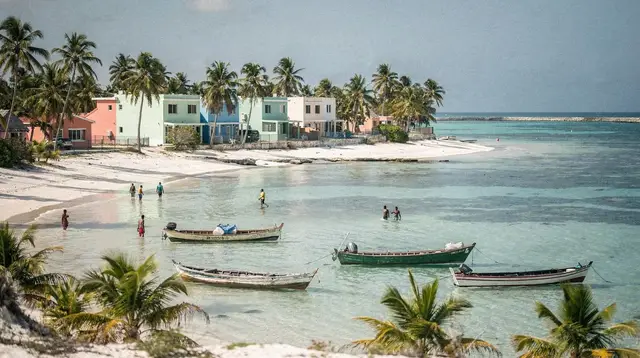
Walk the malecon (the seafront promenade) in Bayahibe and what you notice first is how much of it is still a working fishing harbor rather than a resort front. Small wooden fishing boats sit alongside the larger catamarans and speedboats used for island excursions. Fishermen mend nets in the morning a few meters from where tour operators load coolers and life jackets onto boats headed to Saona. It is a mixed-use waterfront, not a manicured resort marina, and that contrast is part of what makes it worth a stop even for visitors who are not boarding a boat that day.
The village proper is small: a grid of a few streets back from the water, lined with dive shops, casual seafood restaurants, a handful of small hotels and guesthouses, and stalls selling snorkel gear and sun hats. It has none of the scale of the Bavaro hotel strip. That is deliberate context, not a complaint — Bayahibe was a fishing settlement long before it became a tourist gateway, and it still functions as one alongside the tour trade.
A small church, Iglesia de Bayahibe, sits above the harbor and is one of the older structures in the area; some tour operators point it out as a brief photo stop rather than a destination in itself. The town beach, Playa Bayahibe, is modest by the standards of Bavaro or Macao — narrow, used by locals, and mostly a place to wait for a boat rather than a sunbathing destination. For a fuller rundown of the village’s own sights, see things to do in Bayahibe.
Why boats to Saona and Catalina leave from here
Isla Saona and Isla Catalina both sit inside or near Cotubanama national park, and Bayahibe is the closest developed harbor with the infrastructure — docks, fuel, boat storage, tour operator offices — to run daily excursions out to them. Boats from Bayahibe reach the Saona area in roughly 45 minutes to just over an hour depending on the route and boat type; a common pattern is a fast boat out and a slower catamaran back (or the reverse), often with a stop at a sandbar known locally as the natural pool along the way.
None of the detail about what happens on that water — the natural pool, the starfish, snorkeling around Isla Catalina’s reef wall — belongs on this page; the natural pool and starfish rules guide and the why you should not lift the starfish piece cover that in detail. What matters here is the logistics: the boat leaves from Bayahibe, not from anywhere in Punta Cana, and if you are staying in a Punta Cana hotel, the road transfer to Bayahibe is the first leg of your day, not an afterthought. Some excursions sold as “from Punta Cana” bus you to Bayahibe and put you straight on a boat; others bundle time in the village itself. Read the itinerary before booking so you know which one you are getting. If you are trying to decide between the two islands in the first place, Saona vs Catalina: which island lays out the trade-offs.
If your main goal is the islands themselves, the useful next pages are the Saona island excursions and Catalina island snorkeling trips guides, or the Bayahibe day trip from Punta Cana guide for the whole day planned out. If your interest is diving specifically, Bayahibe is also a base in its own right for that, covered below and in the Bayahibe scuba diving guide.
Diving and the reef out from Bayahibe
Independent of any island excursion, Bayahibe has a genuine standing as a scuba diving base on this coast. Several dive operators run out of the village, offering reef dives, wall dives and wreck dives along the coastline and around Isla Catalina, whose reef wall is one of the better-known dive sites in the eastern Dominican Republic. Divers who want more than a single day trip sometimes base themselves in or near Bayahibe for a few days specifically for repeat diving, rather than treating it purely as a stop en route to Saona.
Certification levels and dive-site access vary by operator and season, and current conditions matter more here than a fixed itinerary, so treat any specific site list as a starting point to confirm with the dive shop or through your booking platform rather than a guarantee.
Bayahibe and La Romana: how close they really are
La Romana, the larger town nearby, is only about 20-30 minutes from Bayahibe by road — close enough that many visitors treat the two as a single half-day or full-day combination, sometimes adding Altos de Chavon (the reconstructed 1970s Mediterranean-style village above the Chavon river) to the same outing. La Romana itself has its own airport, more shops and services, and functions as the practical hub for this stretch of coast; Bayahibe is smaller and more single-purpose, built around the harbor and the dive and boat trade. The La Romana day trip from Punta Cana and Altos de Chavon day trip from Punta Cana guides cover how to plan that combination in more detail.
If you are deciding how to structure a day trip from Punta Cana, it is worth knowing that a single itinerary can reasonably combine Bayahibe’s waterfront with either an island crossing or a stop in La Romana and Altos de Chavon, but doing all three well in one day is ambitious given the transfer times already involved just getting to this part of the coast.
Getting to Bayahibe from a Punta Cana hotel
There is no train service on this route, and independent bus (guagua) connections from Bavaro to Bayahibe are indirect and slow, generally impractical for a single day trip — see getting around Punta Cana: taxis, Uber, guaguas for how those options compare. In practice, visitors reach Bayahibe one of three ways: as part of a packaged excursion that includes the transfer (the most common option, since it removes the logistics), by private transfer or hired driver, or by rental car if comfortable driving Dominican roads and traffic (see renting a car in the Dominican Republic before choosing that option). Whichever way you go, budget the full 1h15-1h45 each way from Bavaro or Cap Cana, more from Uvero Alto, and factor that into how early you need to leave and how tired the day will feel by the return trip.
Booking a packaged trip also means the boat schedule is fixed to your bus arrival, which avoids the risk of missing a departure if you are driving independently and traffic runs long.
Booking a Bayahibe-based activity
A few tours use Bayahibe itself, rather than the offshore islands, as the setting — worth considering if you want time in and around the village and its surrounding countryside rather than a full boat day. An e-bike tour around Bayahibe and its coastline covers more ground than walking without the mud of a buggy tour, and works well if your main interest is the village and nearby countryside rather than the water. For a mix of off-road terrain and horses, a buggy and horseback riding combination out of Bayahibe pairs the two most common inland activities from this base into a single half-day. Cavers and horseback riders sometimes prefer the Cave of Wonders tour with a horseback ride from Bayahibe, which visits a cave system with Taino pictographs rather than staying on the coast.
As with any excursion in the region, treat listed prices as a starting range and confirm the current fare and exact meeting point on the booking platform before you go — schedules and pickup logistics shift, and neither GetYourGuide nor Viator listings are static year to year.
| Activity type | Where it happens | Roughly how long |
|---|---|---|
| Village walk / malecon | Bayahibe itself | 1-2 hours |
| E-bike or buggy tour | Bayahibe and surrounding countryside | Half day |
| Scuba diving | Reefs and wrecks offshore, Isla Catalina wall | Half day to full day |
| Saona or Catalina boat trip | Boards in Bayahibe, spends the day on/around the islands | Full day |
| La Romana / Altos de Chavon add-on | 20-30 minutes away by road | Half day, combinable |
What to skip or plan around
Do not book a Saona or Catalina excursion expecting a quick trip if you are staying in Punta Cana — with the road transfer both ways plus the boat crossing, it is realistically a 9-10+ hour day from hotel pickup to drop-off. If you only have a short window, a Bayahibe village stop combined with La Romana is a more realistic half-day than trying to add an island crossing on top of the drive. And the town beach itself is not a reason to make the trip; it is a functional harbor beach, not a destination stretch of sand — save the beach time for Bavaro, Macao or the islands themselves.
Practical notes for the day
Bring cash in USD or DOP for small purchases in the village — card acceptance is inconsistent at the smaller stalls and shacks, and pesos versus dollars generally is covered in money, tipping and taxes in Punta Cana. Tap water is not safe to drink here any more than elsewhere in the country, so carry bottled water, especially if you are also diving or doing an active tour in the heat (more on that in can you drink the water in Punta Cana). If your day includes a restaurant meal in Bayahibe, expect the standard 18% ITBIS tax plus 10% service charge added to the bill, same as anywhere else in the Dominican Republic. Sun protection matters more here than it might seem — much of the village and the boat crossings offer little shade, and a day that starts with a 1h15+ transfer plus hours on the water adds up to a lot of sun exposure before you are even aware of it.
Bayahibe in context
For readers weighing where to spend a south-coast day, Bayahibe’s role is specific: it is the departure point, the working harbor, and a modest diving and village stop in its own right — not the island scenery itself, and not the bigger town with the airport and shops nearby. Saona and Catalina hold the beach and reef payoff; La Romana holds the services and Altos de Chavon; Bayahibe holds the boats, the malecon, and the honest fact that getting here from Punta Cana takes longer than most listings admit. For a multi-day plan built around this stretch of coast rather than a single excursion, see the south coast: Bayahibe in three days itinerary.