The most common mix-up: what “Punta Cana” actually means
Ask ten people where they’re going and most will say “Punta Cana,” even if their hotel is in Bávaro, Cap Cana or Uvero Alto. That’s not wrong exactly, but it does hide useful detail. Punta Cana, in the strict sense, is the cape at the eastern tip of the Dominican Republic — a geographic point, not a town with a center and a main square. Over the past few decades the name got stretched to cover the entire resort strip that grew up along this coast, and that’s how most travel sites, airlines and hotel booking pages use it today.
Inside that stretched-out “Punta Cana,” the actual sectors are distinct, and the differences matter for planning:
- Bávaro is the densest hotel zone, with the widest run of coconut-palm beach and the largest concentration of all-inclusive resorts.
- Cap Cana sits to the south, more upscale, built around a marina and several golf courses, and it’s also where Scape Park and the Hoyo Azul cenote are located.
- Macao, a bit north of Bávaro, is a public beach rather than a resort sector — known for surf and buggy excursions, not hotel front doors.
- Uvero Alto, further north still, is a separate hotel sector covered on its own destination page, with longer airport transfers than Bávaro or Cap Cana.
This page — punta-cana-bavaro — covers Bávaro, Cap Cana and Punta Cana proper: the resort strip itself, where the hotels, the airport, the catamaran piers, the buggy ranches and Hoyo Azul all sit within about half an hour of each other. Think of it as the hub for this part of the site. For the details of each sector, and for excursions further afield, the individual Bávaro, Cap Cana and Macao pages go deeper than we will here.
Getting here: Punta Cana International Airport (PUJ)
Almost everyone staying in this region flies into Punta Cana International Airport (PUJ), the main gateway for the whole tourist zone. From PUJ, most Bávaro and Cap Cana hotels are 15-40 minutes by road — Cap Cana properties near the marina tend to be on the shorter end, and hotels toward the far north of Bávaro edge toward 40 minutes depending on traffic. If you’re headed to Uvero Alto instead, plan on 40-60 minutes; see the airport transfers guide for fixed-rate taxis versus prearranged private transfers.
Two paperwork items trip people up every year. First, the e-Ticket, a free online form covering both entry and exit, is mandatory for every traveler and should be filled out before you fly — it isn’t optional, and airline check-in staff will ask for it. Second, the tourist card (10 USD) most travelers assume they’ll pay for at the airport is usually already bundled into the plane ticket price for flights to the Dominican Republic; check your airline’s terms rather than budgeting for it twice. The full rules live on the e-Ticket and entry requirements guide.
Saint-Domingue has its own airport, Las Américas (SDQ), entirely separate from PUJ — relevant only if you’re combining a Punta Cana stay with a Santo Domingo add-on, which we cover further down.
Bávaro: the resort strip’s main beach
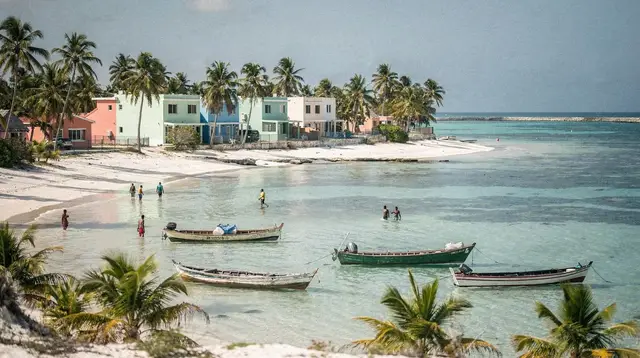
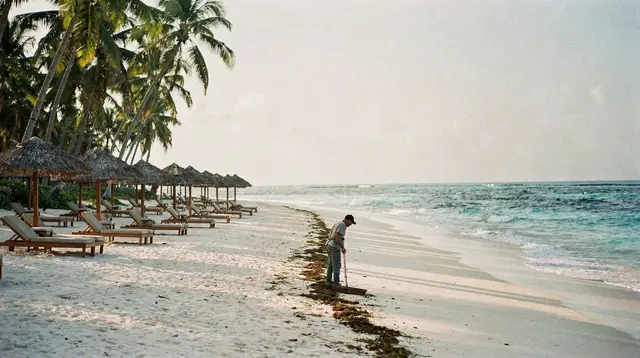
Bávaro is where most of the region’s hotel rooms sit, along a long, wide stretch of white sand backed by coconut palms. It’s less a single beach than a continuous run of resort frontage, and the sea here is generally calm and shallow close to shore, which is part of why it’s the default choice for families and first-time visitors.
Excursions bookable straight from a Bávaro hotel’s tour desk or online tend to fall into a few categories: catamaran trips with a stop at a sandbar or “natural pool,” buggy and ATV tours inland, and water sports along the beach itself. If you want the boat-plus-sandbar combination without the alcohol-forward crowd, a half-day snorkeling and natural-pool boat trip covers the same stretch of shallow reef more quietly than the adults-only party boats. If you do want the louder version — open bar, music, a stop at the sandbar — an adults-only party boat to the natural pool is the more direct option, and it’s worth knowing going in that these trips run at a fixed pace with a set itinerary rather than a flexible charter.
For a break from the beach, buggy tours through the countryside behind Bávaro are the most-booked land excursion in the region; the buggy and ATV tours guide breaks down the difference between a shared buggy, a solo ATV and a Polaris side-by-side, which matters more than most listings admit — see also the buggy vs ATV vs Polaris comparison if you’re unsure which to book.
Cap Cana: Scape Park, Hoyo Azul and the marina
South of Bávaro, Cap Cana is a different kind of development — gated, built around a marina lined with yachts, several golf courses, and generally higher-end hotels than the Bávaro strip. For day-trippers staying elsewhere in the region, Cap Cana’s main draw is Scape Park, an adventure park built around Hoyo Azul, a striking cenote reached by a short walk or a buggy ride through dry forest.
It’s worth being precise here because the comparison to Mexico comes up constantly: Hoyo Azul is a genuine cenote, but it’s in the Dominican Republic, inside Scape Park, in Cap Cana — not in the Yucatán, and not part of any Mexican cenote circuit. The two countries’ cenotes are unrelated beyond the geology being similar limestone karst. Scape Park entry covering the cenote, zip lines and cave sections is the standard way to see Hoyo Azul along with the park’s other features in one visit; a full breakdown of what’s included and what costs extra sits on the Hoyo Azul and Scape Park guide.
Cap Cana’s marina is also the departure point for some fishing and private-charter trips, covered on the private tours guide and the fishing guide, if you’d rather book a boat outright than join a group excursion.
Macao Beach: the public alternative
Macao Beach sits north of Bávaro and is genuinely different from the resort beaches to its south: it’s public, undeveloped along most of its length, and known for a stronger, more consistent surf break, which makes it a poor swimming beach for small kids but a good one for surf lessons and photos of the more dramatic Dominican coastline. It’s also the launch point for a cluster of buggy tours that don’t overlap with the Bávaro ranches.
A buggy tour that finishes with beach time at Macao
is a straightforward way to combine the two, and a quad-bike tour through the countryside and coastal trails covers similar ground for travelers who’d rather drive solo than ride two-up in a buggy. The Macao buggy and ATV tours guide and the Macao horseback riding guide both go into more detail on this sector specifically.
Indigenous Eyes and the Puntacana Resort side
On the northern edge of this region, inside the Puntacana Resort development, the Indigenous Eyes Ecological Reserve is a network of freshwater lagoons and walking trails through dry tropical forest — a quieter, cheaper counterpart to Scape Park, without the cenote or the zip lines but with more birdlife and a genuinely different pace. It’s covered in full on the Indigenous Eyes guide, and it pairs well with a golf morning at one of the resort’s courses if that’s on your itinerary — see the golf guide note that this is listed under guides, so the actual path is golf in Punta Cana and Casa de Campo.
What this region is a base for — and what it isn’t
Staying in Bávaro or Cap Cana puts you within easy reach of everything on this page, but it’s worth being upfront about what’s genuinely close and what requires a real travel day, because tour listings don’t always say so:
| Excursion | Where it actually departs from | Realistic time from a Bávaro/Cap Cana hotel |
|---|---|---|
| Scape Park / Hoyo Azul | Cap Cana | 20-40 min drive, half-day trip |
| Macao Beach / buggy tours | Macao | 20-30 min drive, half-day trip |
| Isla Saona | Bayahibe | 1h15-1h45 drive, then a boat — full day |
| Whale watching | Samaná Bay (mid-Jan to late March only) | Long drive or overnight, seasonal |
| Santo Domingo colonial zone | Santo Domingo | 2h30-3h drive — full day |
If an excursion sold as “leaving from Punta Cana” is actually a Saona, Los Haitises or Santo Domingo trip, the transfer time above is baked into the tour length whether or not the listing mentions it. Our regional pages for La Romana-Bayahibe, Samaná-Miches and Santo Domingo-South Coast cover those trips and their honest travel times in full.
Money, tipping and practical basics for this region
The currency is the Dominican peso (DOP, RD$) — this is not a euro-using country, and euros are not commonly accepted or exchanged in this region. US dollars are widely accepted for excursions booked online and in tourist-facing shops and restaurants, but change is typically handed back in pesos. Restaurant bills normally already include 18% ITBIS tax plus 10% service (“ley”), so a menu price is rarely the final price — the money, tipping and taxes guide covers this in more detail than we need here.
A few other basics that apply across Bávaro and Cap Cana: tap water isn’t safe to drink, so stick to bottled or filtered water even at higher-end resorts; the region runs on Atlantic Time (UTC-4) year-round with no daylight-saving shift; and outlets are the US-style 110-120V, type A/B, so European visitors need an adapter, not a voltage converter. The emergency number nationwide is 911.
When to come, and what to plan around
The driest and least humid stretch runs December through April, which is also the highest-priced and most crowded period at hotels and on popular excursions. The rest of the year, May through November, is more humid with more rain, and it overlaps with the hurricane season (June-November), with the highest storm risk from August to October. None of this makes a trip in the wetter months a bad idea — showers are often short and afternoon-focused — but it’s worth checking the hurricane season guide before booking non-refundable excursions in that window.
One more seasonal factor specific to this coastline: sargassum, a brown seaweed, can wash up on beaches here, most often between April and October, in amounts that vary a lot year to year and even week to week. No one can promise a sargassum-free beach in those months; the sargassum season guide explains what affects how much shows up and what resorts do about it.
Planning your days
For a first stay in this region, three to five days gives enough time for beach days in Bávaro, one adventure day (buggy or Scape Park), and a bit of slack for weather. If you’re combining this base with excursions further afield — Saona, Samaná, Santo Domingo — each of those realistically eats a full day once you count the drive, so budget accordingly rather than trying to stack two long excursions back to back. The how many days in Punta Cana guide and the three-day Punta Cana itinerary both build out sample schedules from this exact base.
If you’re deciding between staying here versus Uvero Alto further north, the trade-off comes down to transfer time versus a quieter beach — the Punta Cana vs Bávaro vs Cap Cana vs Uvero Alto comparison lays out the differences sector by sector.
Frequently asked questions about Punta Cana and Bávaro
Is Punta Cana a town or a region?
Punta Cana is technically the cape at the eastern tip of the Dominican Republic. In everyday travel use, the name covers the whole resort strip from Bávaro up to Uvero Alto, but Bávaro, Cap Cana, Macao and Uvero Alto are distinct sectors, not different names for the same beach.
How far is the airport from my hotel in Bávaro or Cap Cana?
Most hotels in Bávaro and Cap Cana are 15-40 minutes from Punta Cana International Airport (PUJ) by road, depending on traffic and the exact property. Hotels further north in Uvero Alto run 40-60 minutes.
Can I visit Isla Saona directly from a Bávaro or Cap Cana hotel?
Not directly by boat. Saona excursions depart from Bayahibe, which is roughly 1h15-1h45 by road from most Punta Cana hotels, so the drive happens before you even board a boat. It is a full-day trip, not a short hop.
What is Hoyo Azul and where is it?
Hoyo Azul is a cenote inside Scape Park, in Cap Cana, a short drive from Bávaro. It is not in Mexico and not connected to the Yucatán cenote circuit; it is a standalone freshwater sinkhole reached on foot or by buggy through the park.
Is Macao Beach the same as the beach at my Bávaro hotel?
No. Macao Beach is a public beach known for surf and buggy tours, separate from the private beachfront of Bávaro’s resorts. It is a short drive north and worth a half-day visit rather than a swap for your hotel beach.
Can I see whales from Punta Cana or Bávaro?
No. Humpback whales are seen in Samaná Bay, roughly mid-January to late March, and nowhere near Punta Cana or Bávaro. A whale-watching day trip from here is possible only in that window and involves a long drive or an overnight.
How long is the drive to Santo Domingo from here?
About 2h30-3h by road, not the one hour some listings imply. It is a legitimate day trip if you leave early, but budget the full day rather than treating it as a quick add-on.
Do I need cash, and in what currency, for excursions and tips?
The official currency is the Dominican peso (DOP, RD$). US dollars are widely accepted for excursions and in tourist areas, but change usually comes back in pesos, so carrying some small-denomination pesos helps for tips and incidentals.