Things to do in Bayahibe before and after your boat trip
Is there anything to do in Bayahibe besides catching a boat to the islands?
Yes. Bayahibe is a working fishing village with its own beach, a small colonial-era church, dive shops, waterfront restaurants and buggy or ebike tours into the surrounding countryside. Most visitors only pass through it on their way to a boat, but it holds an hour or two on its own before or after a departure.
Bayahibe is a village, not just a dock
Most people who type “Bayahibe” into a search bar are looking for a boat to Isla Saona or Isla Catalina, and that is understandable — this is the departure point for both, deep inside the Cotubanama national park. But Bayahibe itself is a real fishing village with a beach, a small church, dive shops and a waterfront strip of restaurants that predates the tourism around it. If you have time before or after a boat trip, or you are staying nearby rather than in a Punta Cana resort, it is worth understanding what the village offers on its own.
This page stays on land. For what happens once you board a boat, see the dedicated guides on Saona Island excursions and Catalina Island snorkeling trips. This page also does not cover La Romana, the larger city nearby that functions as a practical hub and airport point but is a separate place with its own things to do.
If you are coming from a Punta Cana hotel, keep in mind that reaching Bayahibe already means a meaningful stretch of road before any boat is involved — this page covers the village once you have arrived, not the transfer itself. For transfer planning, see Punta Cana airport transfers and getting around Punta Cana.
Bayahibe belongs to the La Romana–Bayahibe area, the south-coast region built around the Cotubanama national park, the dive industry and the boat departures to Saona and Catalina. It is a different part of the country from the Punta Cana–Bavaro hotel zone or the Uvero Alto–Higuey sector further north, and it is worth keeping that regional picture in mind when planning: a stop in Bayahibe is not an extension of a Bavaro beach day, it is a separate stretch of coast with its own rhythm.
The village and the waterfront
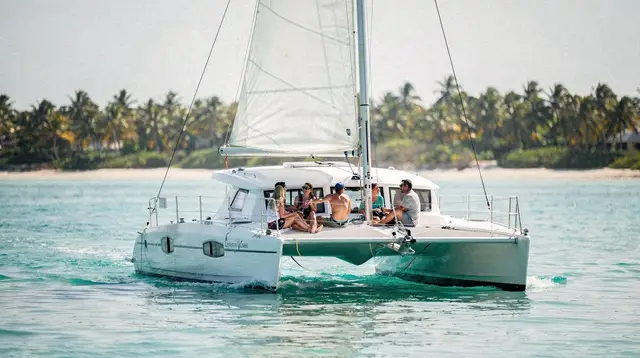
Bayahibe’s center is small enough to see on foot in under an hour. The main street runs down to the water, lined with seafood restaurants, a few souvenir stalls and dive shop storefronts. It has the feel of a place that grew around fishing and diving before boat tours to the islands became the main business — locals still keep small boats along the shore, alongside the larger catamarans and speedboats used for excursions.
The village church, Iglesia Nuestra Señora del Rosario de Bayahibe, is a modest colonial-era building near the center, notable more for its age and the calm it offers than for grandeur. It is a quick stop rather than a destination in itself, but it gives a sense of Bayahibe’s history as a settlement, distinct from the newer excursion infrastructure around the port.
The port area itself is worth ten minutes of attention even if you are not boarding anything: it is where boats load for Saona and Catalina each morning, and watching the loading process gives a clearer sense of how those trips actually run than any brochure. If a boat trip is on your itinerary, arriving with a little slack before the stated departure time means you can watch this without rushing.
Away from the tourist-facing storefronts, Bayahibe still runs partly on a working fishing cooperative that predates the dive shops and excursion booths lining the main street. Small skiffs go out early for the day’s catch, and it is not unusual to see nets being mended on the sand a short walk from where the day’s snorkeling boats are loading. This working side of the village is easy to miss if you only pass through on the way to a boat, but it is part of what separates Bayahibe from a purpose-built resort strip.
Bayahibe beach
Playa Bayahibe is a small public beach right in the village, calmer and less developed than the wide resort beaches around Bavaro or Cap Cana. There is no large hotel strip behind it — instead, a handful of local restaurants sit along the sand, serving grilled fish and Dominican staples. It is not a place to expect loungers and full beach service the way an all-inclusive would provide, and it is not meant to compete with Saona’s sandbanks or Punta Cana’s main beaches. It works as a place to sit for an hour with a meal before or after a boat, rather than as a beach-day destination on its own.
For beaches worth planning around specifically, see best beaches in Punta Cana; Bayahibe’s beach is a convenience next to the port, not one of the region’s headline stretches of sand.
Diving and snorkeling without going to the islands
Bayahibe is one of the main dive bases on this coast, and several operators run trips to nearby reefs and cenotes that do not require the longer boat ride out to Saona or Catalina. This is a genuinely separate option from the island excursions, useful for visitors who want to dive rather than spend a day on a group boat trip with snorkeling stops.
a Los Melones snorkeling trip run from Bayahibe, staying close to shore rather than heading out to the islandsFor a broader look at where diving and snorkeling fit into a Punta Cana trip, see Punta Cana scuba diving and best snorkeling spots near Punta Cana.
Bayahibe’s dive and adventure operators also reach inland cenotes and cave systems in the surrounding limestone country, a different kind of outing from either the reef dives or the island boats. These trips pair naturally with the region’s diving culture without requiring an early boat departure, and they are covered in more detail in Bayahibe cenotes, caves and waterfalls.
Buggies, ebikes and the countryside around the village
Away from the water, several operators run buggy, ATV and ebike tours that use Bayahibe as a starting point and head into the surrounding countryside and coastline rather than out to sea. These are a way to see rural Dominican life, small settlements and coastal trails without an island in the itinerary at all.
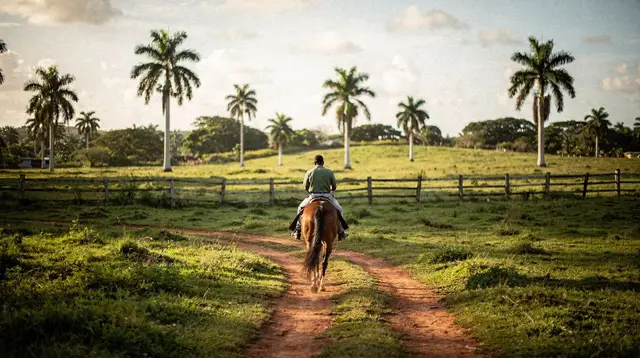
an ebike route through Bayahibe’s surroundings, a quieter alternative to a buggy convoy a combined buggy and horseback outing that mixes off-road riding with a slower pace on horsebackIf buggies and off-road tours across the region interest you generally, see Bayahibe buggy and ATV tours and the comparison at buggy vs ATV vs Polaris, which to book.
Bayahibe as a base versus a Punta Cana resort
Some visitors choose to stay in or near Bayahibe rather than in the Punta Cana–Bavaro hotel zone, trading the resort strip’s beach and nightlife for proximity to the boats, the dive shops and a quieter village feel. It is a legitimate choice, especially for divers or anyone building a trip mainly around Saona, Catalina and the south coast, but it is a genuinely different base from Bavaro, Cap Cana or Uvero Alto, with a smaller selection of hotels and a much smaller stretch of beach. For a broader comparison of where to stay across the region, see where to stay in Punta Cana and Punta Cana vs Bavaro vs Cap Cana vs Uvero Alto.
Getting a feel for the village: guided walks and craft workshops
For visitors who want context rather than just a walk, a guided village tour explains Bayahibe’s transition from fishing settlement to tourism hub, including the fishing cooperative that still operates alongside the dive and excursion businesses.
a guided walk through Bayahibe that covers its fishing history and how the village became a departure point for the islandsThere is also a small-scale craft option nearby, for visitors who want a souvenir with some substance to it rather than a stall purchase:
a hands-on session making jewelry from larimar, the blue stone found only in the Dominican Republic
Larimar is sold widely around Bayahibe and La Romana, and quality varies; for background on telling a real piece from a dyed imitation, see larimar and amber, what to buy.
A day trip inland: Monkeyland
One option that starts from Bayahibe but leaves the village entirely is a half-day visit to a monkey sanctuary, aimed mainly at families or anyone wanting an inland stop that has nothing to do with boats or beaches.
a half-day sanctuary visit departing from Bayahibe, focused on wildlife rather than water
This works well combined with an early or late boat departure, filling the other half of the day without retracing the same waterfront.
Food in Bayahibe
The restaurants along the Bayahibe waterfront lean toward fresh seafood, grilled fish and simple Dominican plates, generally priced for the tourist traffic passing through on excursion days but still more modest than resort dining. Menus commonly list prices in Dominican pesos (RD$), with US dollars widely accepted; expect the standard 18% ITBIS tax plus a 10% service charge (“ley”) added to the bill, as almost everywhere in the country. For a wider view of Dominican food beyond Bayahibe’s tourist strip, see the Dominican food guide.
Weather and the best time to stop in Bayahibe
Bayahibe follows the same tropical pattern as the rest of the country’s coast, with temperatures generally in the 26–31°C range year-round. The drier, less humid stretch runs roughly from December to April, while May through November is more humid, and the official hurricane season runs from June to November, with the highest risk in August, September and October. Because Bayahibe sits on the south coast rather than the more exposed east coast, it is less consistently affected by the sargassum seaweed that can reach the beaches around Punta Cana and Bavaro between April and October, though conditions still vary by year and by exact stretch of coast. For a fuller picture of seasons, see best time to visit Punta Cana, hurricane season in Punta Cana and sargassum season in Punta Cana.
Nearby: La Romana and Altos de Chavón
Bayahibe is close enough to La Romana and the Altos de Chavón replica village that both are realistic add-ons to a day that starts or ends at the Bayahibe dock, rather than a separate trip from a Punta Cana hotel. Altos de Chavón in particular is often combined with a Bayahibe stop precisely because the two sit on the same stretch of coast. See things to do in Altos de Chavón, Altos de Chavón day trip from Punta Cana and La Romana day trip from Punta Cana for how that combination usually works.
Practical notes for a stop in Bayahibe
| What | Detail |
|---|---|
| Distinct from | La Romana (nearby city, different place) |
| Main draw | Departure point for Saona and Catalina boats |
| On its own | Village walk, beach, church, dive shops — roughly 1–2 hours |
| Currency | Dominican peso (RD$); USD widely accepted, change usually in pesos |
| Restaurant tax | 18% ITBIS + 10% service, added to the bill |
| Water | Tap water is not safe to drink; use bottled |
| From Punta Cana | A genuinely long stretch of road before Bayahibe is reached at all |
Prices for tours, meals and excursions here are given as ranges or general guidance; check the current listing on GetYourGuide or Viator for the exact rate on your travel dates.
Bayahibe FAQ: village, port and boat departures
Is Bayahibe the same place as La Romana?
No. Bayahibe is a small fishing village on the coast, while La Romana is the larger nearby city. They are often paired in trip planning because La Romana is a practical hub, but they are distinct places with different things to do.
Do I need to arrive early in Bayahibe before a Saona or Catalina boat?
Most operators ask guests to be at the dock 30 to 60 minutes before departure. Arriving a little earlier gives time to walk the waterfront or grab a coffee, but this page does not cover the boat trips themselves, which have their own guides.
Is Bayahibe worth visiting if I am not going to Saona or Catalina?
It can be, mainly for the beach, the dive shops and the village atmosphere, but it is a modest destination on its own. Most people who are not boarding a boat visit for a meal or a short walk rather than a full day.
What is Bayahibe beach like?
It is a small public beach in the village, more low-key than the resort beaches around Punta Cana or Bavaro, with local restaurants along the sand rather than large hotel infrastructure.
Can I dive or snorkel directly from Bayahibe without a boat to the islands?
Yes. Several dive operators run trips from Bayahibe to nearby reefs and cenotes without going as far as Saona or Catalina, which is a separate option from the island boat excursions.
Is Bayahibe safe to walk around in the evening?
The village center and waterfront are generally calm and used to visitors, but as anywhere, sticking to lit, populated areas at night and using a taxi after dark is the sensible approach.
How long should I plan for Bayahibe itself, not counting a boat excursion?
An hour or two is enough to see the village, the beach and the port area. It is not a full-day destination unless combined with diving, an ebike tour or a countryside excursion.
For the boat trips that most visitors ultimately come to Bayahibe for, see Saona Island excursions, Catalina Island snorkeling trips, and the comparison at Saona vs Catalina, which island. For planning the trip out from Punta Cana, see Bayahibe day trip from Punta Cana and south coast Bayahibe, three days.
Tours for your first trip to Punta Cana on GetYourGuide
Verified deep-linked GetYourGuide tours. Book through these links and we earn a small commission at no cost to you.
GetYourGuide does not provide a product photo for this activity — the image shows the meeting point, photographed by us.