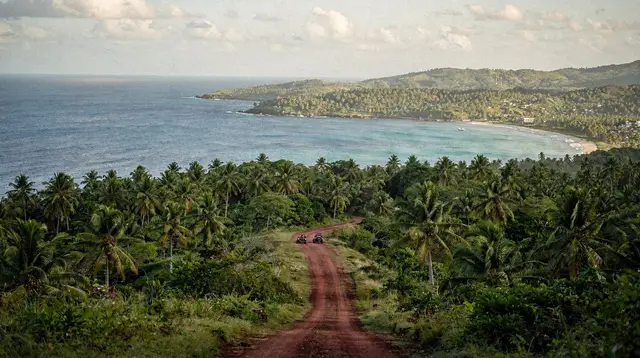
Bayahibe buggy and ATV tours
What is a Bayahibe buggy or ATV tour actually like?
It is a half-day land excursion through the countryside around Bayahibe village - dirt roads, small plantations and rural hamlets - not a boat trip to Saona or Catalina. Tours run in the USD 50-100 range per person depending on operator and whether you drive a buggy or an ATV, with the exact price and departure time confirmed on the GetYourGuide or Viator listing.
What a Bayahibe buggy tour actually covers
Bayahibe is best known as the departure port for boat trips to Isla Saona and Isla Catalina, inside the Cotubanama national park. That is a different product from what this page covers. A buggy or ATV tour from Bayahibe stays entirely on land, running along the dirt roads and tracks that thread through the countryside behind the village - small plantations, rural hamlets, a few river crossings and open scrubland. If you are looking for the island boat trips, see our Saona island excursions guide instead. This page is about the land-based buggy and ATV circuits.
The appeal is straightforward: most visitors to this part of the Dominican Republic see the resort strip, the beach and maybe a boat to Saona, but never the working countryside a few kilometers inland. A buggy tour puts that in reach for a half day, without requiring any diving or snorkeling skill.
Village, plantations and countryside
Bayahibe itself started as a fishing village, and it still has that character away from the tour-operator kiosks near the port - small houses, fishing boats pulled up on the sand, a modest church. Buggy routes typically leave the village and head into the surrounding countryside, passing:
- Small-scale plantations growing cacao, coconut and tropical fruit, sometimes with a stop where a guide explains how cacao is grown and processed on a working farm
- Rural hamlets where daily life continues largely independent of the resort economy nearby
- Dirt tracks through scrub and light forest, occasionally crossing a stream or shallow river
- Open stretches where the buggies can pick up more speed, which is usually the part riders remember most
Some operators route through or near reserves with local wildlife - monkeys in particular show up on a few itineraries, distinct from the more manicured Indigenous Eyes ecological park near Punta Cana proper. None of this involves getting on a boat; if the itinerary you’re looking at mentions Saona, a catamaran or snorkeling over a reef, you’re looking at a different, boat-based excursion.
Buggy or ATV: what’s the difference
| Vehicle | Seating | Who it suits | License needed |
|---|---|---|---|
| Buggy | Two seats, side by side, one steering wheel | Couples, one confident driver plus a passenger | Usually driver only |
| ATV / quad | Single rider | Solo riders comfortable on a motorbike or scooter | Usually yes, per rider |
A buggy works well when only one person in a pair wants to drive - the other rides along without needing any license or prior experience. An ATV puts each rider in full control of their own machine, which some find more engaging but also more physically demanding, especially over an extended dusty or muddy stretch. Most Bayahibe operators offer one or the other, occasionally both on the same booking page, so check which vehicle a specific tour actually uses before booking.
a buggy tour from Bayahibe that also includes horseback riding along the coast is a common combination for visitors who want two land-based activities in one outing rather than committing a full day to just one.
What a typical half day looks like
Most tours run three to four hours door to door, including hotel pickup, a safety briefing, the driving portion and one or two stops. A rough shape:
- Pickup from your hotel or a Bayahibe meeting point, plus a short briefing on vehicle controls and hand signals used by the lead guide
- A convoy departure - groups usually move together at a pace set by the guide, not a free-for-all
- A stop at a plantation, farm or scenic viewpoint, often with a chance to taste local produce such as cacao or coffee
- A further stretch of open track, generally the fastest and dustiest section
- Return to the meeting point, with time to rinse off or change before heading back
a jungle-focused off-road buggy route through the countryside behind Bayahibe leans into the more forested, uneven sections rather than open farmland, which is worth knowing if you prefer one landscape over the other.
Exact timing, stops and inclusions vary by operator and season - check the specific listing on GetYourGuide or Viator for the current itinerary and departure times rather than assuming a fixed schedule.
Practical details before you book
What to wear. Closed shoes are close to mandatory - sandals do not hold up on a buggy or ATV, and the dirt roads throw up dust in the dry season, mud after rain. A bandana or buff to cover the nose and mouth cuts down on inhaled dust considerably. Sunscreen matters on the open stretches, and it is worth bringing a change of clothes for the ride back.
Age and license rules. Operators generally require a valid driving license from the driver’s home country to take the wheel of a buggy or the controls of an ATV, with a minimum age around 18. Passengers on a two-seat buggy usually face no license requirement, though a minimum age still applies at most operators. These rules are set by each company, not standardized across the island, so confirm on the listing you’re booking.
Weather. Rain turns the dirt tracks to mud, which some riders enjoy and others do not. Tours generally still run in light rain; a downpour or the operator’s own safety call can lead to a reschedule. This part of the coast sits in the wetter season roughly from May to November, so afternoon showers are a real possibility outside the December-to-April dry stretch.
Price. Buggy and ATV tours in this area typically fall in the USD 50-100 per person range, with variation based on vehicle type (a shared buggy seat generally costs less per person than a solo ATV), group size, and whether the package adds horseback riding, a farm visit or a meal. Treat any number here as a rough guide only - the fare and any add-ons should be confirmed on the current GetYourGuide or Viator page before you pay.
Getting to Bayahibe for a buggy tour
Bayahibe sits south of the main Punta Cana and Bavaro hotel strip, and most buggy operators build hotel pickup into the price. From a Punta Cana or Bavaro resort, expect a real road transfer of roughly an hour or more each way before the buggy portion even begins - this is not a five-minute hop, and it’s worth checking the listed pickup window rather than assuming an early wake-up isn’t required.
La Romana is the nearest city and a common alternative pickup point or overnight base for visitors splitting time between the buggy tour and a look at Altos de Chavon, though the detail of that replica village belongs on its own page, not here. Travelers based in Bayahibe itself, rather than commuting from Punta Cana, obviously face the shortest transfer of all - some tours even offer a meeting point walking distance from the village center.
a Bayahibe jungle safari by buggy that departs directly from the village area suits travelers already staying in or near Bayahibe rather than transferring from a Punta Cana resort.
Bayahibe versus Las Terrenas: not the same tour
It’s easy to confuse the two because both are called “buggy tours in the Dominican Republic,” but the setting is genuinely different. Bayahibe is a small fishing-village-turned-boat-port on the south coast, inside Cotubanama national park, with a quieter, more agricultural landscape behind it - plantations, hamlets, modest infrastructure. Las Terrenas, by contrast, sits in the Samana peninsula further north and is a considerably more developed beach resort town, with its own buggy circuits running through a different landscape and a livelier tourist atmosphere. Neither is objectively better - they’re simply different trips through different parts of the country, and confusing one for the other is a common planning mistake.
Combining a buggy tour with other Bayahibe activities
A buggy or ATV outing pairs naturally with other land-based or water-based options around Bayahibe without needing to change base:
- A separate boat trip to Isla Saona or Isla Catalina on a different day, since combining both a buggy tour and a full-day island trip in one day is a long, tiring stretch
- a Larimar stone jewelry-making session in Bayahibe as a lower-key half day if you’d rather split the buggy dust with something calmer
- a half-day Monkeyland safari departing from Bayahibe, a wildlife-focused alternative if the buggy element matters less to you than seeing animals up close
- A day exploring things to do in Bayahibe more broadly, including snorkeling and diving options that don’t involve a vehicle at all
For a wider view of how a buggy tour fits into a full visit to this stretch of coast, see our Bayahibe day trip from Punta Cana planning guide, or the broader things to do in Bayahibe overview.
Frequently asked questions about Bayahibe buggy and ATV tours
Does a Bayahibe buggy tour include a boat trip to Saona island?
No. Buggy and ATV tours stay on land, around Bayahibe and the countryside behind it. Isla Saona and Isla Catalina are separate boat excursions departing from the same port; they are covered on a dedicated page for this area, not here.
How long does a Bayahibe buggy tour last?
Most run half a day, roughly 3 to 4 hours including pickup and a stop or two along the route. A few operators combine buggy time with a short beach or swimming stop, which adds time. Check the exact duration on the tour listing before booking.
Is a buggy or an ATV better for a first-timer?
A buggy seats two side by side with one set of controls, so one person drives and the other rides along, which suits couples or anyone unsure about handling a quad alone. An ATV is a single-rider quad bike, more physical and better suited to someone comfortable on a motorbike or scooter.
Do I need a driving license to drive a buggy or ATV in Bayahibe?
Most operators ask for a valid driving license from your home country for the driver’s seat, and set a minimum age, typically around 18. Passengers usually have no license requirement. Confirm the operator’s own rules when booking, since they vary.
What should I wear on a Bayahibe buggy or ATV tour?
Closed shoes, clothes you do not mind getting dusty or muddy, and a bandana or buff for the face are the practical basics - the dirt roads throw up dust in dry weather and mud after rain. Sunscreen and a hat help on the open stretches, and a change of clothes back at the hotel is worth having.
Is Bayahibe’s buggy tour different from the one in Las Terrenas?
Yes. Bayahibe is a fishing-village-turned-boat-port on the south coast, inside Cotubanama national park, with quieter countryside and plantation tracks. Las Terrenas, in the Samana peninsula further north, is a more developed beach resort town with its own separate buggy circuits and a different landscape and atmosphere.
Can I book a Bayahibe buggy tour from a Punta Cana hotel?
Yes, most tours include hotel pickup from the Punta Cana and Bavaro area, but expect a real road transfer of roughly an hour or more each way before the buggy portion even starts, since Bayahibe sits well south of the main resort strip. Confirm pickup times and drive length on the specific listing.
How much does a Bayahibe buggy or ATV tour cost?
Typical pricing sits in the USD 50-100 per person range depending on vehicle type, group size and whether food or a snorkeling add-on is included. Treat that as a rough guide only - check the GetYourGuide or Viator page for the operator’s current rate before booking.
Buggy tours and speedboat thrills around Punta Cana on GetYourGuide
Verified deep-linked GetYourGuide tours. Book through these links and we earn a small commission at no cost to you.
GetYourGuide does not provide a product photo for this activity — the image shows the meeting point, photographed by us.