Why you should not lift the starfish out of the water
The photo everyone takes at the natural pool
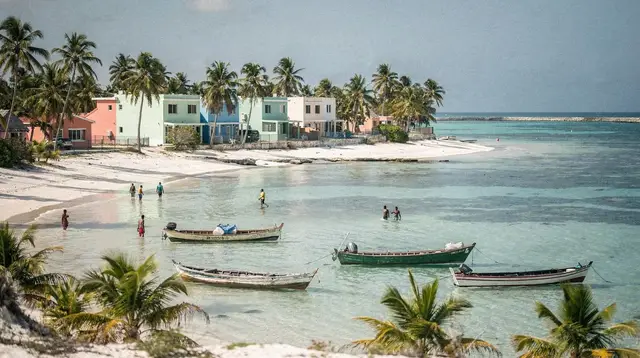
On most boat trips toward Isla Saona, the catamaran or speedboat stops at a sandbank the crews call the natural pool, somewhere in the shallow water between Bayahibe and the island itself. The water is waist-deep, warm, and often has starfish resting on the sandy bottom. Someone always reaches down, picks one up, holds it flat on their palm for a photo, and puts it back a minute or two later. I did it myself the first time I took this trip, years before I ever wrote about Punta Cana for a living. Nobody on the boat told me not to. The crew didn’t stop me. It just seemed like a harmless thing everyone did.
It isn’t harmless, and I want to explain why in plain terms, without turning this into a lecture.
This sandbank stop is usually just one part of a longer Saona Island excursion or a day trip from Bayahibe, and it’s worth thinking about the natural pool moment on its own terms rather than as background scenery for the rest of the day.
What actually happens when you lift one out
A starfish breathes and moves using a water vascular system, a network of small tube feet that only works properly underwater. Out of the water, that system starts to struggle within seconds. The animal also relies on ambient water pressure and temperature to function; the difference between the sea and a warm human palm in direct sun is not trivial for an animal built for one narrow set of conditions. None of this kills a starfish instantly, and a lot of them do survive being handled for a photo. But repeated handling, day after day, boat after boat, adds up on animals living in a spot that dozens of tour boats visit every single day of the season. A sandbank that every operator stops at is not a quiet corner of the reef. It’s one of the most handled patches of shallow water in this part of the Dominican Republic.
I’m not going to pretend there’s a official number backing this up, or a fine you’ll be handed for doing it. There isn’t one that I’ve found written anywhere reliable, and I’d rather say that honestly than invent a rule to sound authoritative. What I can say is that the water vascular system I mentioned above is a documented biological fact, not a guess, and it points in one direction: starfish are not designed to be lifted into open air, even briefly, even gently.
This isn’t really about starfish alone
I bring this up on a site about excursions because it’s a small, specific example of something bigger: the reflex to treat marine life as a prop the moment it’s in front of a camera. It shows up in a few other places on Caribbean boat trips too, not just with starfish. Feeding wild fish so they swarm for a video. Touching coral, which can die from the oils on human skin even from a light touch. Holding conch shells that still have an animal inside. None of these come with a posted sign on a public sandbank in the middle of the sea, which is exactly why the habit persists. Nobody is enforcing it, so it keeps happening.
I’d rather be straightforward about this than moralize about it. You’re not a bad tourist if you’ve already done it, or if you’re currently the sort of person who would. Almost everyone who does it has no idea it matters, because nobody along the way told them. That’s the actual failure here, and it isn’t the traveler’s alone. It’s the guide who says nothing, and the operator who lets the stop happen without a word about what’s okay to touch.
The same reflex shows up in other wildlife moments sold around here, and I’d point you to what I’ve written about swimming with dolphins and the ethics involved if that’s on your list, or about dolphins and wildlife around Punta Cana more generally. The pattern is the same one as at the starfish sandbank: an animal treated as a prop rather than something you’re lucky to see at all.
What I’d suggest instead
Look, don’t touch. The starfish in the natural pool near Bayahibe are genuinely worth seeing, and you don’t lose anything by leaving them exactly where they are for the photo. Kneel down, get low, shoot the water and the sand color and the starfish sitting there undisturbed. It’s a better photo anyway, honestly, than the stiff arm-out shot with a slightly stressed animal on your palm.
If you’re snorkeling anywhere in the waters around Cotubanama national park, whether that’s near Isla Saona, Isla Catalina, or the reef closer to Bayahibe itself, the same logic extends to anything alive on the seabed: sea urchins, sponges, coral, anemones. None of it needs your hands on it to be worth the trip out there.
If a crew member on your boat offers to pick one up for you, it’s fine to say you’d rather not, or to just not take the photo. I’ve done exactly that on trips since, and nobody’s pushed back. Most people, once it’s pointed out, agree it makes sense.
If you’d rather spend your time in the water looking properly instead of standing around a sandbank, it’s worth checking out the best snorkeling spots near Punta Cana and, specifically for this stretch of coast, the snorkeling trips around Isla Catalina. For a closer look at the reef itself rather than just the surface, scuba diving out of Bayahibe and learning to dive in Punta Cana both put you at eye level with the same marine life, hands off, for longer than a sandbank stop ever allows.
A note on the rest of the trip
This one habit doesn’t sum up a whole excursion, and it shouldn’t stop you from booking a boat day toward Saona or Catalina. Those trips are genuinely one of the better reasons to base yourself on this coast; I’ve written separately about what a full day out there actually involves, transfer time included in the day trip to La Romana, and about the difference between Saona and Catalina if you’re deciding between the island trips. This page is only about the one small moment at the sandbank, because it’s the moment where a good day out quietly turns into something worse for the animals living there, and it’s the easiest possible thing to fix.
Saona Island, Bayahibe and Isla Catalina are all part of the same stretch of coast, and each has its own things worth doing beyond the boat trips: see things to do in Bayahibe and things to do on Saona Island for the fuller picture. If you’re comparing boat formats before you book, party boats versus snorkel catamarans covers the difference, and this whole page fits into the broader list of travel mistakes to avoid in Punta Cana. Spending a few days based in this area rather than doing it as a single day trip is also an option worth knowing about; I’ve laid one out in three days on the south coast around Bayahibe.
If you want a boat day with more room and a bit more structure than the standard group catamaran, the Saona Crusoe VIP trip runs a smaller-group format with the usual sandbank stop included. For something closer to shore and less about wildlife altogether, the adults-only party boat trip to the natural pool is a different kind of day, more about the boat itself than the marine life around it. If seeing things underwater rather than handling them is the actual draw, diving trips off Isla Catalina put you in the water properly, at a reef built for exactly that kind of close, hands-off look. And if you’d rather skip the marine stop altogether, a buggy or quad tour inland gets you a full excursion day with no sandbank involved at all.
Starfish, Saona and Bayahibe boat trips: your questions
Will a starfish die if I pick it up for a few seconds?
Not necessarily, and most survive brief, gentle handling. The concern is cumulative: a heavily visited sandbank like the one near Bayahibe gets handled by dozens of boats a day through the season, and repeated stress adds up on the same population of animals.
Is there a fine or an official rule against touching starfish in the Dominican Republic?
I haven’t found one posted or enforced at the sandbanks themselves. The case here is a biological one, not a legal one: starfish rely on a water-based system to function and are not built to be lifted into open air.
Do the boat crews say anything about it?
In my experience, rarely. Most crews focus on getting people to the sandbank and back on schedule and don’t volunteer guidance on handling wildlife. Don’t expect a warning; it’s worth applying the same caution on your own.
Is this only an issue at the Saona natural pool?
That sandbank is the most visited example because so many Bayahibe-based boats stop there, but the same starfish, coral, and reef life around Isla Catalina and the wider Cotubanama national park deserve the same hands-off approach.
What about picking up shells or coral instead?
Coral can be damaged even by a light touch from human skin, and shells on the seabed sometimes still have a living animal inside. The same look-don’t-touch approach applies to all of it, not just starfish.
Does saying no to the crew make the day awkward?
Not in my experience. Declining a starfish photo or asking not to have one placed in your hands is a small, ordinary moment, and most people on the boat don’t react to it at all.
Are there other common tourist habits on this coast that cause similar harm?
Feeding wild fish so they crowd for photos and standing on coral while snorkeling are the two I’d flag next. Both come from the same instinct to interact rather than observe, and both are avoidable with the same look-don’t-touch habit.
Should this change whether I book a Saona or Bayahibe boat trip?
No. The trip itself is worth doing; I’ve covered what a full day out there involves elsewhere. This is about one specific moment during it, not a reason to skip the excursion.
tours.Practical
Verified deep-linked GetYourGuide tours. Book through these links and we earn a small commission at no cost to you.
GetYourGuide does not provide a product photo for this activity — the image shows the meeting point, photographed by us.